| Citation: | Haiyan Jiang, Bowen Zheng, Guang Hu, Lian Kuang, Tianyu Zhou, Sizheng Li, Xinyi Chen, Chuangjun Li, Dongming Zhang, Jinlan Zhang, Zengyan Yang, Jiuming He, Hongtao Jin. Spatially resolved metabolomics visualizes heterogeneous distribution of metabolites in lung tissue and the anti-pulmonary fibrosis effect of Prismatomeris connate extract[J]. Journal of Pharmaceutical Analysis, 2024, 14(9): 100971. doi: 10.1016/j.jpha.2024.100971

|
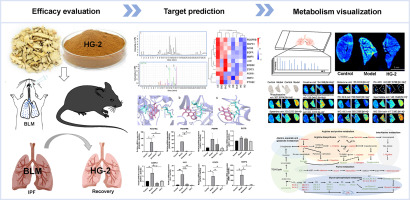
Pulmonary fibrosis (PF) is a chronic progressive end-stage lung disease. However, the mechanisms underlying the progression of this disease remain elusive. Presently, clinically employed drugs are scarce for the treatment of PF. Hence, there is an urgent need for developing novel drugs to address such diseases. Our study found for the first time that a natural source of Prismatomeris connata Y. Z. Ruan (Huang Gen, HG) ethyl acetate extract (HG-2) had a significant anti-PF effect by inhibiting the expression of the transforming growth factor beta 1/suppressor of mothers against decapentaplegic (TGF-β1/Smad) pathway. Network pharmacological analysis suggested that HG-2 had effects on tyrosine kinase phosphorylation, cellular response to reactive oxygen species, and extracellular matrix (ECM) disassembly. Moreover, mass spectrometry imaging (MSI) was used to visualize the heterogeneous distribution of endogenous metabolites in lung tissue and reveal the anti-PF metabolic mechanism of HG-2, which was related to arginine biosynthesis and alanine, asparate and glutamate metabolism, the downregulation of arachidonic acid metabolism, and the upregulation of glycerophospholipid metabolism. In conclusion, we elaborated on the relationship between metabolite distribution and the progression of PF, constructed the regulatory metabolic network of HG-2, and discovered the multi-target therapeutic effect of HG-2, which might be conducive to the development of new drugs for PF.

| [1] |
K. Kitowska, D. Zakrzewicz, M. Konigshoff, et al., Functional role and species-specific contribution of arginases in pulmonary fibrosis, Am. J. Physiol. Lung Cell Mol. Physiol. 294 (2008) L34-L45.
|
| [2] |
B. Ley, H.R. Collard, T.E.J. King, Clinical course and prediction of survival in idiopathic pulmonary fibrosis, Am. J. Respir. Crit. Care Med. 183 (2011) 431-440.
|
| [3] |
G. Raghu, M. Selman, Nintedanib and pirfenidone. New antifibrotic treatments indicated for idiopathic pulmonary fibrosis offer hopes and raises questions, Am. J. Respir. Crit. Care Med. 191 (2015) 252-254.
|
| [4] |
J. Katzen, M.F. Beers, Contributions of alveolar epithelial cell quality control to pulmonary fibrosis, J. Clin. Investig. 130 (2020) 5088-5099.
|
| [5] |
D. Wang, B. Deng, L. Cheng, et al., A novel and low-toxic peptide DR3penA alleviates pulmonary fibrosis by regulating the MAPK/miR-23b-5p/AQP5 signaling axis, Acta Pharm. Sin. B 13 (2023) 722-738.
|
| [6] |
D. Fournier, S. Jouneau, G. Bouzille, et al., Real-world safety profiles of pirfenidone and nintedanib in idiopathic pulmonary fibrosis patients, Pulm. Pharmacol. Ther. 76 (2022), 102149.
|
| [7] |
T.M. Dempsey, S. Payne, L. Sangaralingham, et al., Adoption of the antifibrotic medications pirfenidone and nintedanib for patients with idiopathic pulmonary fibrosis, Ann. Am. Thorac. Soc. 18 (2021) 1121-1128.
|
| [8] |
H. Wu, Y. Yu, H. Huang, et al., Progressive pulmonary fibrosis is caused by elevated mechanical tension on alveolar stem cells, Cell 180 (2020) 107-121. e17.
|
| [9] |
B. Selvarajah, I. Azuelos, D. Anastasiou, et al., Fibrometabolism-an emerging therapeutic frontier in pulmonary fibrosis, Sci. Signal. 14 (2021), eaay1027.
|
| [10] |
W. Roque, F. Romero, Cellular metabolomics of pulmonary fibrosis, from amino acids to lipids, Am. J. Physiol. Cell Physiol. 320 (2021) C689-C695.
|
| [11] |
B. Seeliger, A. Carleo, P.D. Wendel-Garcia, et al., Changes in serum metabolomics in idiopathic pulmonary fibrosis and effect of approved antifibrotic medication, Front. Pharmacol. 13 (2022), 837680.
|
| [12] |
S. Feng, J. Bai, S. Qiu, et al., Iridoid and phenolic glycosides from the roots of Prismatomeris connata, Nat. Prod. Commun. 7 (2012) 561-562.
|
| [13] |
J. Hao, S. Feng, S. Qiu, et al., Anthraquinone glycosides from the roots of Prismatomeris connata, Chin. J. Nat. Med. 9 (2011) 42-45.
|
| [14] |
S. Feng, Q. Guan, T. Chen, et al., In vitro activities of 3-hydroxy-1, 5, 6-trimethoxy-2-methyl-9, 10-anthraquinone against non-small cell lung carcinoma, Arch Pharm. Res. (Seoul) 35 (2012) 1251-1258.
|
| [15] |
S. Feng, Z. Wang, M. Zhang, et al., HG30, a tetrahydroanthraquinone compound isolated from the roots of Prismatomeris connate, induces apoptosis in human non-small cell lung cancer cells, Biomed. Pharmacother. 100 (2018) 124-131.
|
| [16] |
J. Deng, C. Zhou, Z. Zheng. Protective effect of alcohol extract of Prismatomeris connate on hepatic fibrosis induced by carbon tetrachloride in rats. Lishizhen Med. Mater. Med. Res. 19 (2008) 1339-1341.
|
| [17] |
Y. Zhang, Z. Yang, J. Li, et al., Study on the chemical constituents of the active sites of Prismatomeris connate against liver fibrosis. Chin. J. New Drugs. 25 (2016), 3.
|
| [18] |
Z. Yang, Y. Zhang, J. Li, et al., Analysis of metabolites of scopolide in rat liver microsomal incubation system and effect of drug-containing serum on rat liver stellate cells. Chin. J. Comp. Med. (2020), 6.
|
| [19] |
Z. Yang, C. Bai, Q. Zhang, et al., Screening test for effective fraction of against hepatic fibrosis from prismatomerisconnata, Chin. J. Integr. Tradit. West. Med. Liver Dis. 25 (2015) 284-285, 297.
|
| [20] |
J. He, F. Tang, Z. Luo, et al., Air flow assisted ionization for remote sampling of ambient mass spectrometry and its application, Rapid Commun. Mass Spectrom. 25 (2011) 843-850.
|
| [21] |
O. Distler, K.B. Highland, M. Gahlemann, et al., Nintedanib for systemic sclerosis-associated interstitial lung disease, N. Engl. J. Med. 380 (2019) 2518-2528.
|
| [22] |
P. Wei, Y. Xie, P.W. Abel, et al., Transforming growth factor (TGF)-β1-induced miR-133a inhibits myofibroblast differentiation and pulmonary fibrosis, Cell Death Dis. 10 (2019), 670.
|
| [23] |
D. Chanda, E. Otoupalova, S.R. Smith, et al., Developmental pathways in the pathogenesis of lung fibrosis, Mol. Asp. Med. 65 (2019) 56-69.
|
| [24] |
S.K. Tirunavalli, M. Kuncha, R. Sistla, et al., Targeting TGF-β/periostin signaling by sesamol ameliorates pulmonary fibrosis and improves lung function and survival, J. Nutr. Biochem. 116 (2023), 109294.
|
| [25] |
R. Rajesh, R. Atallah, T. Barnthaler, Dysregulation of metabolic pathways in pulmonary fibrosis, Pharmacol. Ther. 246 (2023), 108436.
|
| [26] |
E. Bargagli, R.M. Refini, M. D'Alessandro, et al., Metabolic dysregulation in idiopathic pulmonary fibrosis, Int. J. Mol. Sci. 21 (2020), 5663.
|
| [27] |
Y. Nishioka, S. Homma, T. Okubo, et al., Design of phase 2 study of TAS-115, a novel oral multi-kinase inhibitor, in patients with idiopathic pulmonary fibrosis, Contemp. Clin. Trials Commun. 23 (2021), 100832.
|
| [28] |
Z.W. Liu, M.Y. Zhao, X.L. Su, et al., The antifibrotic effect and mechanism of a novel tyrosine kinase inhibitor, ZSP1603, in preclinical models of pulmonary fibrosis, Eur. Rev. Med. Pharmacol. Sci. 24 (2020) 1481-1491.
|
| [29] |
S. Chen, Y. Wei, S. Li, et al., Zanubrutinib attenuates bleomycin-induced pulmonary fibrosis by inhibiting the TGF-β1 signaling pathway, Int. Immunopharmacol. 113 (2022), 109316.
|
| [30] |
M. Abdalla, L. Thompson, E. Gurley, et al., Dasatinib inhibits TGFβ-induced myofibroblast differentiation through Src-SRF Pathway, Eur. J. Pharmacol. 769 (2015) 134-142.
|
| [31] |
O. Mammoliti, A. Palisse, C. Joannesse, et al., Discovery of the S1P2 antagonist GLPG2938 (1-[2-Ethoxy-6-(trifluoromethyl)-4-pyridyl]-3-[[5-methyl-6-[1-methyl-3-(trifluoromethyl) pyrazol-4-yl] pyridazin-3-yl] methyl] urea), a preclinical candidate for the treatment of idiopathic pulmonary fibrosis, J. Med. Chem. 64 (2021) 6037-6058.
|
| [32] |
O. Mammoliti, K. Jansen, S. El Bkassiny, et al., Discovery and optimization of orally bioavailable phthalazone and cinnolone carboxylic acid derivatives as S1P2 antagonists against fibrotic diseases, J. Med. Chem. 64 (2021) 14557-14586.
|
| [33] |
E.-A. Stylianaki, C. Magkrioti, E.M. Ladopoulou, et al., “Hit” to lead optimization and chemoinformatic studies for a new series of Autotaxin inhibitors, Eur. J. Med. Chem. 249 (2023), 115130.
|
| [34] |
H. Lei, Z. Cao, H. Wu, et al., Structural and PK-guided identification of indole-based non-acidic autotaxin (ATX) inhibitors exhibiting high in vivo anti-fibrosis efficacy in rodent model, Eur. J. Med. Chem. 227 (2022), 113951.
|
| [35] |
T.M. Maher, P. Ford, K.K. Brown, et al., Ziritaxestat, a novel autotaxin inhibitor, and lung function in idiopathic pulmonary fibrosis: the ISABELA 1 and 2 randomized clinical trials, JAMA 329 (2023) 1567-1578.
|
| [36] |
M.L. Decaris, J.R. Schaub, C. Chen, et al., Dual inhibition of αvβ6 and αvβ1 reduces fibrogenesis in lung tissue explants from patients with IPF, Respir. Res. 22 (2021), 265.
|
| [37] |
Y. Huang, J. Deng, Y. Tian, et al., Mangostanin derivatives as novel and orally active phosphodiesterase 4 inhibitors for the treatment of idiopathic pulmonary fibrosis with improved safety, J. Med. Chem. 64 (2021) 13736-13751.
|
| [38] |
S. Li, G. Hu, L. Kuang, et al., Unraveling the mechanism of ethyl acetate extract from Prismatomeris connata Y. Z. Ruan root in treating pulmonary fibrosis: Insights from bioinformatics, network pharmacology, and experimental validation, Front. Immunol. 14 (2024), 1330055.
|
| [39] |
J.C. Hewlett, J.A. Kropski, T.S. Blackwell, Idiopathic pulmonary fibrosis: epithelial-mesenchymal interactions and emerging therapeutic targets, Matrix Biol. 71-72 (2018) 112-127.
|
| [40] |
R. Derynck, Y. Zhang, Smad-dependent and Smad-independent pathways in TGF-β family signalling, Nature 425 (2003) 577-584.
|
| [41] |
M. Kretzschmar, J. Doody, I. Timokhina, et al., A mechanism of repression of TGFbeta/Smad signaling by oncogenic Ras, Genes Dev. 13 (1999) 804-816.
|
| [42] |
K.M. Mulder, Role of Ras and Mapks in TGFbeta signaling, Cytokine Growth Factor Rev. 11 (2000) 23-35.
|
| [43] |
P. Saha, P. Talwar, Idiopathic pulmonary fibrosis (IPF): disease pathophysiology, targets, and potential therapeutic interventions, Mol. Cell. Biochem. (2023).
|
| [44] |
H. Xie, J. Tan, R. Wang, et al., Expression and significance of HIF-1α in pulmonary fibrosis induced by paraquat, Exp. Biol. Med. 238 (2013) 1062-1068.
|
| [45] |
J. Milara, G. Hernandez, B. Ballester, et al., The JAK2 pathway is activated in idiopathic pulmonary fibrosis, Respir. Res. 19 (2018), 24.
|
| [46] |
H. Ruan, J. Luan, S. Gao, et al., Fedratinib attenuates bleomycin-induced pulmonary fibrosis via the JAK2/STAT3 and TGF-β1 signaling pathway, Molecules 26 (2021), 4491.
|
| [47] |
P. Montero, J. Milara, I. Roger, et al., Role of JAK/STAT in interstitial lung diseases; molecular and cellular mechanisms, Int. J. Mol. Sci. 22 (2021), 6211.
|
| [48] |
Z. Luo, M. Tian, G. Yang, et al., Hypoxia signaling in human health and diseases: implications and prospects for therapeutics, Signal Transduct. Target. Ther. 7 (2022), 218.
|
| [49] |
A.D. Widgerow, Chronic wounds-is cellular ‘reception’ at fault? Examining integrins and intracellular signalling, Int. Wound J. 10 (2013) 185-192.
|
| [50] |
V.J. Craig, L. Zhang, J.S. Hagood, et al., Matrix metalloproteinases as therapeutic targets for idiopathic pulmonary fibrosis, Am. J. Respir. Cell Mol. Biol. 53 (2015) 585-600.
|
| [51] |
A. Pardo, S. Cabrera, M. Maldonado, et al., Role of matrix metalloproteinases in the pathogenesis of idiopathic pulmonary fibrosis, Respir. Res.17 (2016), 23.
|
| [52] |
J. Chen, Y. Wang, J. Ko, Single-cell and spatially resolved omics: advances and limitations, J. Pharm. Anal. 13 (2023) 833-835.
|
| [53] |
Y. Zhou, X. Jiang, X. Wang, et al., Promise of spatially resolved omics for tumor research, J. Pharm. Anal. 13 (2023) 851-861.
|
| [54] |
X. Wang, J. Zhang, K. Zheng, et al., Discovering metabolic vulnerability using spatially resolved metabolomics for antitumor small molecule-drug conjugates development as a precise cancer therapy strategy, J. Pharm. Anal. 13 (2023) 776-787.
|
| [55] |
B. Shan, H. Zhou, C. Guo, et al., Tanshinone II ameliorates energy metabolism dysfunction of pulmonary fibrosis using 13C metabolic flux analysis, J. Pharm. Anal. (2023).
|
| [56] |
K. Bernard, N.J. Logsdon, S. Ravi, et al., Metabolic reprogramming is required for myofibroblast contractility and differentiation, J. Biol. Chem. 290 (2015) 25427-25438.
|
| [57] |
M. Endo, S. Oyadomari, Y. Terasaki, et al., Induction of arginase I and II in bleomycin-induced fibrosis of mouse lung, Am. J. Physiol. Lung Cell Mol. Physiol. 285 (2003) L313-L321.
|
| [58] |
M. Bueno, Y.C. Lai, Y. Romero, et al., PINK1 deficiency impairs mitochondrial homeostasis and promotes lung fibrosis, J. Clin. Investig. 125 (2015) 521-538.
|
| [59] |
P.C. Robinson, L.C. Watters, T.E. King, et al., Idiopathic pulmonary fibrosis. Abnormalities in bronchoalveolar lavage fluid phospholipids, Am. Rev. Respir. Dis. 137 (1988) 585-591.
|
| [60] |
C.W. Agudelo, G. Samaha, I. Garcia-Arcos, Alveolar lipids in pulmonary disease. A review, Lipids Health Dis. 19 (2020), 122.
|
| [61] |
O.D. Maddocks, C.F. Labuschagne, P.D. Adams, et al., Serine metabolism supports the methionine cycle and DNA/RNA methylation through de novo ATP synthesis in cancer cells, Mol. Cell 61 (2016) 210-221.
|
| [62] |
H. Pang, Z. Hu, Metabolomics in drug research and development: the recent advances in technologies and applications, Acta Pharm. Sin. B 13 (2023) 3238-3251.
|
| [63] |
R. Chen, J. Dai, Lipid metabolism in idiopathic pulmonary fibrosis: from pathogenesis to therapy, J. Mol. Med. 101 (2023) 905-915.
|
| [64] |
H. Jin, J. Zhang, G. Hu, et al., Inventors; A pharmaceutical composition for preventing and treating lung injury, a preparation method and its application, International patent PCT/CN2022/086065, 4 November 2022.
|
Figures(1)
Supported by:
Beijing Renhe Information Technology Co. Ltd






 DownLoad: