| Citation: | Wen Guo, Xinyue Zhang, Long Wan, Zhiqi Wang, Meiqi Han, Ziwei Yan, Jia Li, Ruizhu Deng, Shenglong Li, Yuling Mao, Siling Wang. β-Glucan-modified nanoparticles with different particle sizes exhibit different lymphatic targeting efficiencies and adjuvant effects[J]. Journal of Pharmaceutical Analysis, 2024, 14(12): 100953. doi: 10.1016/j.jpha.2024.02.007

|
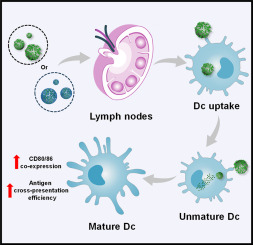
Particle size and surface properties are crucial for lymphatic drainage (LN), dendritic cell (DC) uptake, DC maturation, and antigen cross-presentation induced by nanovaccine injection, which lead to an effective cell-mediated immune response. However, the manner in which the particle size and surface properties of vaccine carriers such as mesoporous silica nanoparticles (MSNs) affect this immune response is unknown. We prepared 50, 100, and 200 nm of MSNs that adsorbed ovalbumin antigen (OVA) while modifying β-glucan to enhance immunogenicity. The results revealed that these MSNs with different particle sizes were just as efficient in vitro, and MSNs with β-glucan modification demonstrated higher efficacy. However, the in vivo results indicated that MSNs with smaller particle sizes have stronger lymphatic targeting efficiency and a greater ability to promote the maturation of DCs. The results also indicate that β-glucan-modified MSN, with a particle size of ∼100 nm, has a great potential as a vaccine delivery vehicle and immune adjuvant and offers a novel approach for the delivery of multiple therapeutic agents that target other lymph-mediated diseases.

| [1] |
Q. Zhang, Y. Zhu, H. Xu, et al., Multifunctional nanoparticle-based adjuvants used in cancer vaccines, Prog. Chem. 27 (2015) 275-285.
|
| [2] |
Y. Kang, S. Li, Nanomaterials: Breaking through the bottleneck of tumor immunotherapy, Int. J. Biol. Macromol. 230 (2023), 123159.
|
| [3] |
X. Dong, J. Liang, A. Yang, et al., A visible codelivery nanovaccine of antigen and adjuvant with self-carrier for cancer immunotherapy, ACS Appl. Mater. Interfaces 11 (2019) 4876-4888.
|
| [4] |
T. Wang, D. Zhang, D. Sun, et al., Current status of in vivo bioanalysis of nano drug delivery systems, J. Pharm. Anal. 10 (2020) 221-232.
|
| [5] |
P. Bhardwaj, E. Bhatia, S. Sharma, et al., Advancements in prophylactic and therapeutic nanovaccines, Acta Biomater. 108 (2020) 1-21.
|
| [6] |
D. Zhang, Z. Lin, M. Wu, et al., Cytosolic delivery of thiolated neoantigen nano-vaccine combined with immune checkpoint blockade to boost anti-cancer T cell immunity, Adv. Sci. (Weinh) 8 (2021), 2003504.
|
| [7] |
I. Pal, J.D. Ramsey, The role of the lymphatic system in vaccine trafficking and immune response, Adv. Drug Deliv. Rev. 63 (2011) 909-922.
|
| [8] |
X. Yu, Y. Dai, Y. Zhao, et al., Melittin-lipid nanoparticles target to lymph nodes and elicit a systemic anti-tumor immune response, Nat. Commun. 11 (2020), 1110.
|
| [9] |
K. Rawat, A. Tewari, X. Li, et al., CCL5-producing migratory dendritic cells guide CCR5+ monocytes into the draining lymph nodes, J. Exp. Med. 220 (2023), e20222129.
|
| [10] |
S. Stritt, K. Koltowska, T. Makinen, Homeostatic maintenance of the lymphatic vasculature, Trends Mol. Med. 27 (2021) 955-970.
|
| [11] |
Q. Zeng, H. Li, H. Jiang, et al., Tailoring polymeric hybrid micelles with lymph node targeting ability to improve the potency of cancer vaccines, Biomaterials 122 (2017) 105-113.
|
| [12] |
M. Tozuka, T. Oka, N. Jounai, et al., Efficient antigen delivery to the draining lymph nodes is a key component in the immunogenic pathway of the intradermal vaccine, J. Dermatol. Sci. 82 (2016) 38-45.
|
| [13] |
L. Kahari, R. Fair-Makela, K. Auvinen, et al., Transcytosis route mediates rapid delivery of intact antibodies to draining lymph nodes, J. Clin. Investig. 129 (2019) 3086-3102.
|
| [14] |
X. Hong, X. Zhong, G. Du, et al., The pore size of mesoporous silica nanoparticles regulates their antigen delivery efficiency, Sci. Adv. 6 (2020), eaaz4462.
|
| [15] |
F. Aranda, D. Llopiz, N. Diaz-Valdes, et al., Adjuvant combination and antigen targeting as a strategy to induce polyfunctional and high-avidity T-cell responses against poorly immunogenic tumors, Cancer Res. 71 (2011) 3214-3224.
|
| [16] |
Y. Qiao, Y. Zhang, J. Chen, et al., A biepitope, adjuvant-free, self-assembled influenza nanovaccine provides cross-protection against H3N2 and H1N1 viruses in mice, Nano Res. 15 (2022) 8304-8314.
|
| [17] |
J. Wagner, D. Gossl, N. Ustyanovska, et al., Mesoporous silica nanoparticles as pH-responsive carrier for the immune-activating drug resiquimod enhance the local immune response in mice, ACS Nano 15 (2021) 4450-4466.
|
| [18] |
T.D. Brown, K.A. Whitehead, S. Mitragotri, Materials for oral delivery of proteins and peptides, Nat. Rev. Mater. 5 (2019) 127-148.
|
| [19] |
Y. Mao, M. Han, C. Chen, et al., A biomimetic nanocomposite made of a ginger-derived exosome and an inorganic framework for high-performance delivery of oral antibodies, Nanoscale 13 (2021) 20157-20169.
|
| [20] |
J. Tian, J. Ma, S. Wang, et al., Increased expression of mGITRL on D2SC/1 cells by particulate β;-glucan impairs the suppressive effect of CD4+CD25+ regulatory T cells and enhances the effector T cell proliferation, Cell. Immunol. 270 (2011) 183-187.
|
| [21] |
J. Quintin, S. Saeed, J.H.A. Martens, et al., Candida albicans infection affords protection against reinfection via functional reprogramming of monocytes, Cell Host Microbe 12 (2012) 223-232.
|
| [22] |
C.A. Rappleye, L.G. Eissenberg, W.E. Goldman, Histoplasma capsulatum alpha-(1, 3)-glucan blocks innate immune recognition by the beta-glucan receptor, Proc. Natl. Acad. Sci. USA 104 (2007) 1366-1370.
|
| [23] |
Y. Mao, X. Wang, C. Chen, et al., Immune-awakening Saccharomyces-inspired nanocarrier for oral target delivery to lymph and tumors, Acta Pharm. Sin. B 12 (2022) 4501-4518.
|
| [24] |
Y. Yang, S. Bernardi, H. Song, et al., Anion assisted synthesis of large pore hollow dendritic mesoporous organosilica nanoparticles: Understanding the composition gradient, Chem. Mater. 28 (2016) 704-707.
|
| [25] |
C. Qi, Y. Cai, L. Gunn, et al., Differential pathways regulating innate and adaptive antitumor immune responses by particulate and soluble yeast-derived β-glucans, Blood 117 (2011) 6825-6836.
|
| [26] |
K.L. Rock, E. Reits, J. Neefjes, Present yourself! by MHC class I and MHC class II molecules, Trends Immunol. 37 (2016) 724-737.
|
| [27] |
S. Han, W. Ma, D. Jiang, et al., Intracellular signaling pathway in dendritic cells and antigen transport pathway in vivo mediated by an OVA@DDAB/PLGA nano-vaccine, J. Nanobiotechnology 19 (2021), 394.
|
| [28] |
Y. Chen, S. De Koker, B.G. De Geest, Engineering strategies for lymph node targeted immune activation, Acc. Chem. Res. 53 (2020) 2055-2067.
|
| [29] |
J. Liu, X. Zhang, Y. Cheng, et al., Dendritic cell migration in inflammation and immunity, Cell. Mol. Immunol. 18 (2021) 2461-2471.
|
| [30] |
S.N. Thomas, E. Vokali, A.W. Lund, et al., Targeting the tumor-draining lymph node with adjuvanted nanoparticles reshapes the anti-tumor immune response, Biomaterials 35 (2014) 814-824.
|
| [31] |
Y. Qian, H. Jin, S. Qiao, et al., Targeting dendritic cells in lymph node with an antigen peptide-based nanovaccine for cancer immunotherapy, Biomaterials 98 (2016) 171-183.
|
| [32] |
H. Jiang, Q. Wang, X. Sun, Lymph node targeting strategies to improve vaccination efficacy, J. Control. Release 267 (2017) 47-56.
|
| [33] |
S.Y. Kim, Y.W. Noh, T.H. Kang, et al., Synthetic vaccine nanoparticles target to lymph node triggering enhanced innate and adaptive antitumor immunity, Biomaterials 130 (2017) 56-66.
|
| [34] |
D.C. Luther, R. Huang, T. Jeon, et al., Delivery of drugs, proteins, and nucleic acids using inorganic nanoparticles, Adv. Drug Deliv. Rev. 156 (2020) 188-213.
|
| [35] |
X. Hong, X. Zhong, G. Du, et al., The pore size of mesoporous silica nanoparticles regulates their antigen delivery efficiency, Sci. Adv. 6 (2020), eaaz4462.
|
| [36] |
H. Li, R. Gou, J. Liao, et al., Recent advances in nano-targeting drug delivery systems for rheumatoid arthritis treatment, Acta Mater. Med. 2 (2023) 23-41.
|
| [37] |
D. Shen, J. Yang, X. Li, et al., Biphase stratification approach to three-dimensional dendritic biodegradable mesoporous silica nanospheres, Nano Lett. 14 (2014) 923-932.
|
| [38] |
S.D. Li, L. Huang, Pharmacokinetics and biodistribution of nanoparticles, Mol. Pharm. 5 (2008) 496-504.
|
| [39] |
P. Dogra, N.L. Adolphi, Z. Wang, et al., Establishing the effects of mesoporous silica nanoparticle properties on in vivo disposition using imaging-based pharmacokinetics, Nat. Commun. 9 (2018), 4551.
|
Figures(1)
Supported by:
Beijing Renhe Information Technology Co. Ltd






 DownLoad: